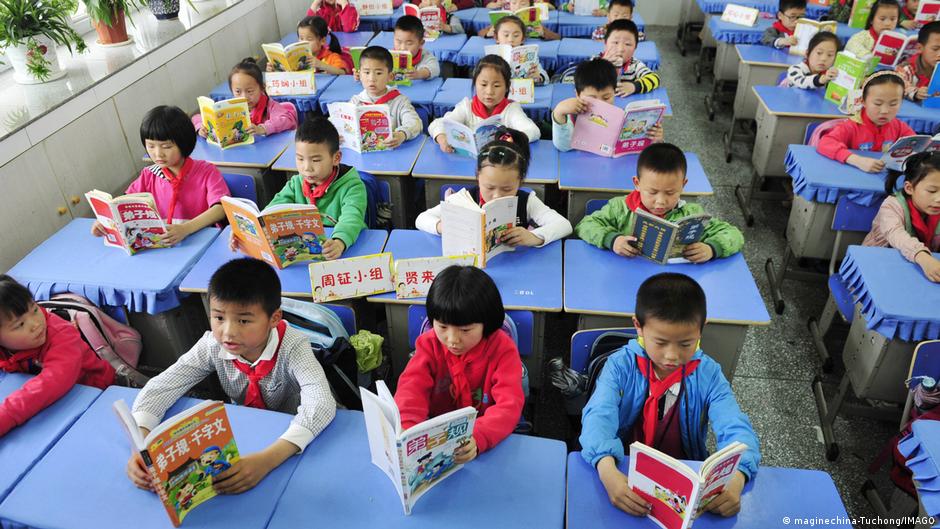
Tang is convinced that no other country in the world has placed as much importance on English as China has.
"Our children desperately begin learning English even before they have properly mastered their native language. Yet we are a civilization that dates back thousands of years. English is just a tool. It's enough to be able to use it. The tradition of revering and emulating Western cultures must come to an end," Tang says in social media.
China: Studying instead of Playing
He became well-known because many of his students achieved full scores on state math exams; in the class of 2011, six students from a single class did so.
Why English? 'AI translates'
Tang's opinion spread quickly online.
"Why cram for English when artificial intelligence can translate everything in seconds? " comments a user from Beijing.
Another suggestion from the southern province of Guangdong is to at least adjust the scoring — for example, to 120 points instead of 150 on the high school graduation exam.

Many parents invest in private tutoring that focuses specifically on exam questions. In addition, all bachelor's students must pass the English exam before being admitted to master's programs. Tang suspects that this could cause many young talents in the natural sciences to fail, even though they have great potential to become top researchers.
No English proficiency, no competitiveness
There is no question that English is also important for STEM subjects. Research on future-oriented topics is typically published in English. There are fears circulating online that cutting back on English instruction could lead to a decline in China's competitiveness. A prominent advocate for English as a required subject is Hu Xijin, former editor-in-chief of the state-run "Global Times," who has previously drawn attention primarily for his nationalistic statements.
Hu emphasizes that foreign language skills are of great importance for every global citizen, "because we live primarily in the present," alluding to a debate over the ungraded history exam. "This present is shaped by globalization. China's opening up is not only state policy but also expands people's scope of action as well as the range of their diverse material and immaterial interests in life. "

Hu went on to say that connections to the outside world should not, therefore, be compared to intellectual ties to ancient history.
"Forcibly pitting them against each other — by asking whether foreign languages or traditional Chinese culture are more important — runs the risk of setting the wrong priorities and unnecessarily politicizing public discussions. "
For him, an open engagement with the outside world is the top priority. English as a core subject also promotes equal opportunity, he noted, as it gives children in rural areas access to this important foreign language and thus to the world.
Why Mandarin Chinese courses are growing in African schools
Similar cultural struggles already took place during the Self-Strengthening Movement in the late 19th century under the Qing Dynasty.
"Learn the superior skills from abroad so that you can later conquer the outside world," said Wei Yuan, a court scholar at the time.
Learning from abroad simply works better in the language used there. Even though it may be becoming apparent that, in some areas, other countries are more interested in — as is already the case today, for example in battery technology for the automotive industry, and humanoid robotics.
This article was originally published in German.
