
Support CleanTechnica's work through . Help us produce all of the despite the challenges of content-scraping AI, antisocial media, inflation, and other hurdles.
Jackery recently showed off the EnergyGuard Max whole home energy storagesystem at their booth at IFA Berlin. The system pairs the Energycore 100kWh battery module with the PowerVault 50 inverter in weather-resistant enclosures. Also at their booth, I had the opportunity to talk with their CEO and founder, Jack Sun. One thing that stuck with me was his key objective of identifying pain points in the transition to sustainable energy and coming up with solutions to those challenges. Those pain points can range from resilience and affordability to useability and aesthetics. When talking to one of their product people, he said that their CEO is always asking: “What problem are you fixing?”
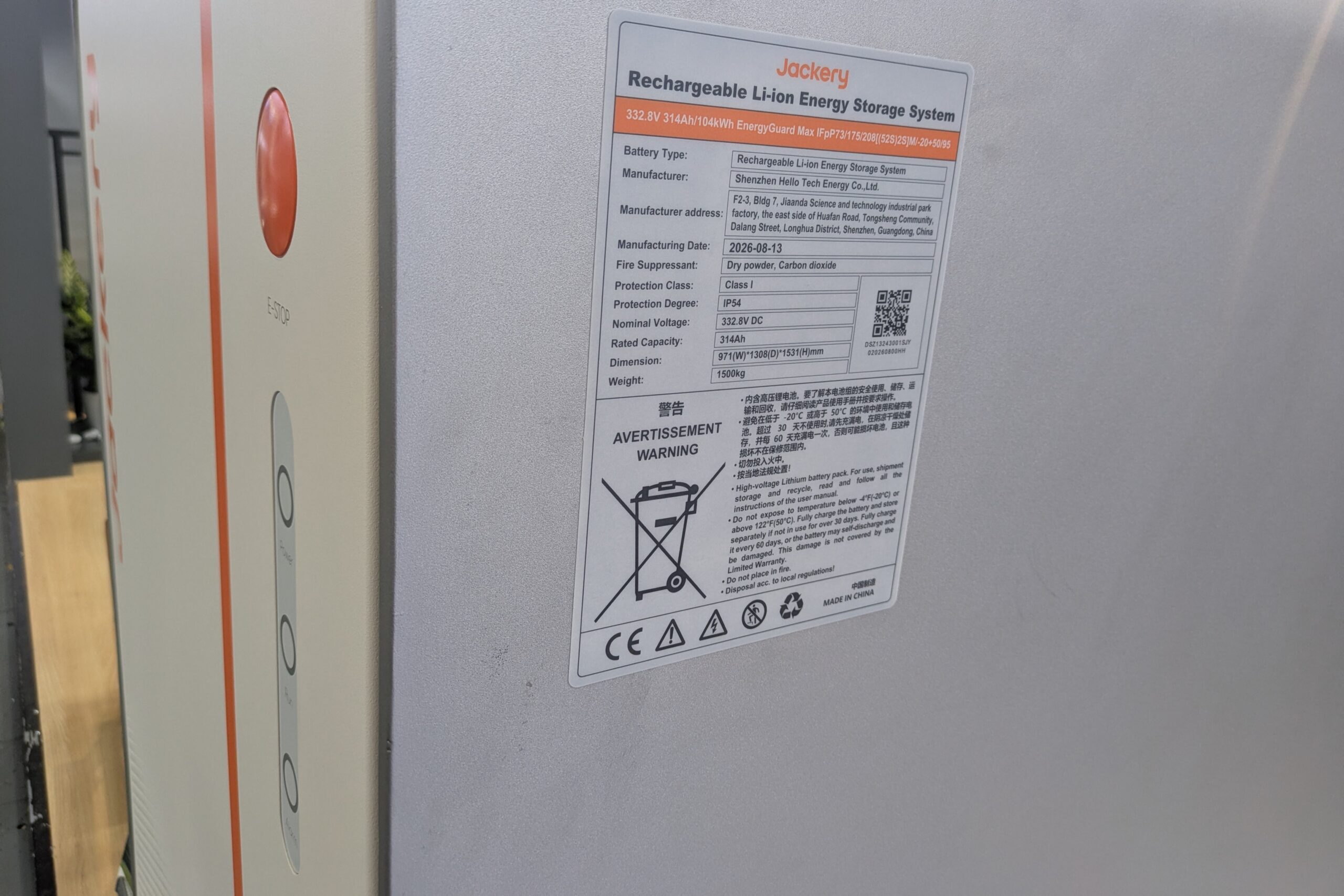
The battery itself has a nominal capacity of 104 kWh and an operating voltage of 332.8 V. As the LFP battery is liquid cooled, like most EVs, it should also hold up well under repeated high-current charging and discharging. Also, like most EVs, it supports OTA updates. An operating temperature down to -20 C (-4 F) makes it suitable for many European locations, outside of Scandinavia.

V2G can also be used to take advantage of the relatively large batteries in vehicles. As people want to be able to drive away when they need to, only a portion of the battery is typically used. However, when combined with the larger battery, this could open new opportunities. During an extended outage, a car could potentially drive to an available charger, recharge, and then return to the home to recharge the large home battery. Like an electric jerry can. The car could also work with the large battery to extend backup power and overall storage capacity.

As this model is intended for Europe, AC input/output has a rated power of 50 kW with a nominal voltage of 230V or 400V. Grid output current is rated at 72.2 A at 400V, supporting unbalanced 3-phase. The battery supports switching times of just 10 ms, less than some UPS batteries. This would make it useful for homes with sensitive electronic equipment. If it were to be offered in the US, the voltages would be different.
The US household consumes an average of 29 kWh per day, although that amount can change dramatically based on home size, construction and location. In Europe, households tend to use half to a third as much, although that also varies. If there was a long-term power disruption, this size of battery could run a home for days, even weeks if consumption is minimized. In addition, if energy prices peak during a cold snap or a heat wave, the battery could avoid the worst of it. And a 100-kWh battery could be especially useful in off-grid applications in Europe.
While warm currents moderate the temperature, Europe is much farther north than many realize. The palm tree lined streets of Monaco are farther north than the frigid nor’easters of Portland, Maine. As such, days are much shorter in the winter. Overcast weather can stretch for days at a time in some locations. As such, a moderately sized home trying to rely on solar for much of their energy could greatly benefit from a battery that can store energy when the sun is available.

Beyond energy storage, another potential application is to buffer power requirements. In older homes, the electrical connections were often made before air conditioning was prevalent and when heat tended to be generated by fossil fuels. In many cases, people who want to go electric, but they run into limitations. An electrical service upgrade can be expensive. If a transformer upgrade is needed, it can lead to significant delays. By charging when energy demand is low and discharging during demand peaks, peak power input from the utility can be reduced.
If connected to the grid, these systems could also be used as part of a virtual power plant (VPP) system to sell energy back to the grid. Potentially, these batteries could pay for themselves quickly, if utilized as part of a VPP.
Pricing has yet to be revealed. The battery itself would undoubtedly be more expensive than something like a Tesla Powerwall due to the larger capacity, but it would cost a fraction as much on a per kWh basis. While I couldn’t get a firm estimate, the 100-kWh battery would cost less than the average new car in the US. Battery priced have come down to a point that a home battery that might have previously been seen as excessive is now becoming accessible. In a country like Germany, where electricity prices are high and dynamic prices can swing dramatically, the ROI potential is clear. In the US, where electricity costs tend to be lower, it would depend largely on the utility rate structure and the ability to be part of a VPP.

Raising Expectations For Home Battery Storage
When the original Nissan LEAF was released with a 24-kWh battery and 73 mi EPA range, some saw it as sufficient. It was significantly more range than the typical commute. Many felt the ability to charge to 80% in around 30 minutes was also an acceptable inconvenience. You could drive for an hour and then charge for half an hour. But technology has progressed. The paradigm for EV usage shifted. Few would find that range and recharging acceptable now. In the process, EVs went from a few early adopters to increasingly mass adoption.When looking at a large battery like the Energycore 100kWh, some will think it is unnecessary. This is not for some households. For an apartment, a balcony solar system like Jackery’s would be a better fit. But these batteries have potential to address the needs of customers, including needs that they didn’t realize they had yet.
In the process, large home batteries can provide greater capability. By expanding the potential use cases, more people will find them valuable. They can potentially solve more problems. Homeowners can find greater energy security and self-sufficiency. Solar has the potential to be better utilized, and EV owners can find more value and flexibility. In the process, the grid can become greener and more stable.
But what do you think? Could large batteries be the next phase in home energy storage?
Sign up for . Or sign up for if daily is too frequent.
CleanTechnica uses affiliate links. See our policy .