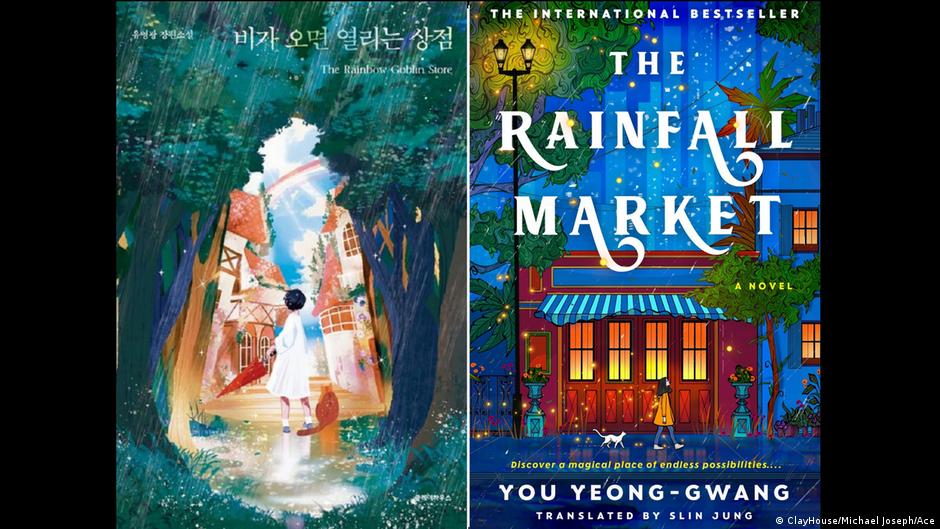
"I'm so grateful that the book has now been published in more than 20 countries. Even more astonishingly, it also appeared on the Der Spiegel bestseller list in Germany," he told DW while attending the 2026 Frankfurt Book Fair.
For a debut novel by an unknown author, it was a massive success, securing publication in 15 languages, including English, German, Spanish and traditional Chinese.
The Rainfall Market tells the story of a mysterious, hidden shop that only opens when it rains. In the shop, visitors can exchange their deepest unhappiness for a ticket to a brand-new destiny. The plot revolves around Serin, a disheartened young girl who stumbles into the marketplace run by whimsical spirits, finding a warm, comforting space.
"In fact, Serin's story is my story," author You said. "For a long time, I even wondered how wonderful it would be if I could sell my unhappiness and use the money to buy happiness. "
While writing the book, he was going through a difficult time himself.
"I had to care for my mother, who had been ill for a long time, and I had also been responsible for supporting my family financially for many years. Life felt incredibly heavy," he reflected.
"But when I was writing, I could immerse myself in the world of the story and, even if only for a short while, forget about those circumstances. That's why writing made me so happy. I truly enjoyed it. "
On the creation of The Rainfall Market
The idea of rain is inspired by his own life. "At that time, my circumstances felt as though it were raining constantly," You said.

The story draws heavily on traditional Korean folklore, serving as a quintessential "healing fiction" tale in which its young protagonist must weigh the true cost of seemingly perfect lives.
"When I was writing, I wasn't consciously trying to write healing fiction. At the time, I didn't even really know that such a label existed. "
He initially planned to publish a book independently and started crowdfunding. But as the funding failed, he used all his savings and printed 200 copies, which bookstores refused to take. In a month, he only sold five copies. "I thought that's it. I really have to give up now.”
"At the time, I had undergone eye surgery and due to complications, I couldn't see, so I started working at a call center, where I could work using my voice. " You said. "During the week, I worked at a call center, and on weekends I went to a computer academy. I learned how to make books on my own for a few years. "
He then taught himself how to use the software needed to create books on his own.
While running one of the crowdfunding campaigns, he started working as a food delivery rider. "The round trip between my home and the area where I delivered food took about four hours each day. So I wrote on my phone's memo app while traveling on the subway. "
"Even when I was going through very difficult circumstances, I was able to keep writing because the moments when I was writing were so joyful. For a little while, I could forget about the difficult situation I was in," You explained.
Finally a breakthrough
"I gathered those pieces of writing together and launched what I intended to be my final crowdfunding campaign," he said.
The campaign was intended to fund the publication of The Rainfall Market.
"To my amazement, the campaign succeeded, and I was able to publish the book commercially for the first time," he said.
How K-pop pushes appetite for Korean ramyun noodles
A new horizon for Hallyu, or the 'Korean Wave': K-Comfort Fiction
Korea's newest soft power is K-literature, which sold about 1.2 million translated copies abroad in 2025 for the second consecutive year.
And You's book belongs to a trending genre called Korean comfort fiction.
"When readers closed the book, I wanted them to feel a little warmth in their hearts," he said.
Although Korean literature was first known for darker, more pragmatic books about societal realities, K-comfort fiction is the child of South Korea's . It offers an answer to the human need for escapism and a transient antidote to the reality of a hyper-competitive education system, brutal job market, and intense corporate pressure.
"When I was writing, I was going through a very difficult time myself, and I wished someone would comfort me. So, I thought, why don't I try reading something like that myself? Why don't I write something that can comfort me? " You wondered.
With burnout on the rise globally, more readers are seeking soul-soothing literature with exhausted protagonists they can relate to. Usually without a need to defeat a villain, the stories follow protagonists with a deep desire for rest, community and emotional repair.
The whimsical fiction aspect is the missing element allowing them to step away from reality. The genre originally gained traction through indie productions, online crowdfunding and endorsements from
How South Korea is cashing in on 'KPop Demon Hunters'
Beyond the book itself, people seem to relate to and appreciate the story of his own life.
"If I have the opportunity, I'd like to share more stories about hope and dreams with people who are going through circumstances similar to mine," said You. "If my story can help one person even a little, in any way, I don't think anything could make me happier. "
Edited by: Srinivas Mazumdaru

