Nearly 3,000 people were killed on September 11, 2001, when Islamist terrorists hijacked four passenger planes and turned them into deadly weapons.
Eleven Germans among the victims
Germany’s head of state struggled to find the right words: "We do not know what political or social consequences what happened today will have — what we have watched unfold on our television screens in shock, barely able to comprehend or even reflect on it. "
It soon emerged that the victims include people from 92 countries, among them 11 Germans.
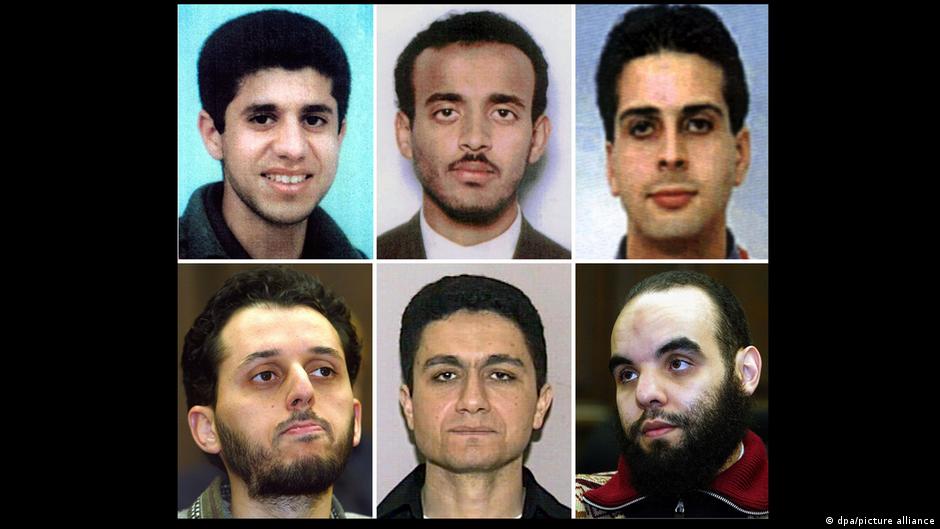
The following day, a rapidly spreading rumor was confirmed: Three of the four suspected hijackers had recently lived in Hamburg. The Islamist terrorists were thought to have been led by Egyptian-born Mohammed Atta, who had come to the northern German city in the early 1990s to study.
Mohammed Atta becomes radicalized at a mosque
At some point, the young man became radicalized, particularly at Hamburg's Al-Quds Mosque, which was later closed by German security authorities. He spent the final three years of his life in an apartment shared with two other suspected attackers in the Harburg district.

The so-called Hamburg terrorist cell was believed to have included six men, among them Moroccan national Mounir al-Motassadeq. He was charged as an accomplice in the world's . In 2003, the Hanseatic Higher Regional Court sentenced him to the maximum 15-year prison term for aiding and abetting thousands of murders and for membership in a terrorist organization.
A man from Bremen at Guantanamo
After serving his sentence, al-Motassadeq was deported to his native Morocco. Another suspected attacker from the circle around pilot Mohammed Atta was Ramzi Binalshibh, who was born in Yemen and had been held without trial at the US detention facility at since 2006.
The detained hundreds of suspects at the prison, which human rights groups and international bodies have described as contrary to international law. Among them was , who was born in Bremen. He was released in August 2006 after nearly five years without evidence establishing his involvement in the terrorist attacks.
Kurnaz later recounted his experience in a book that was adapted into .
Guantanamo still open 20 years on
Gerhard Schröder voiced 'unconditional solidarity'
The Kurnaz case illustrated the pressure on German policymakers in the aftermath of the terrorist attacks in the US. Chancellor addressed parliament the following day.
"Yesterday, September 11, 2001, will go down in history as a dark day for all of us," the Social Democrat said.
He said he had expressed to the American president the deeply felt condolences of the entire German people.
"I also assured him of Germany's unconditional — I emphasize: unconditional — solidarity," Schröder said.
Germany, he added, would offer the US any assistance they requested, "of course, also by identifying and pursuing those responsible for and behind these despicable attacks. "
Bundestag passes anti-terror laws
Schröder's remarks set the tone and opened the door for a series of tougher laws. Just weeks after the attacks, the governing coalition of Social Democrats and Greens unveiled its first so-called security package, involving more funding, more personnel as well as greater powers for police and intelligence agencies.
Religious organizations that had previously been granted special protection could now be banned like other associations if their activities were directed against the Basic Law, Germany's constitutional order based on freedom and democracy, or if they pursued other criminal aims. Less than four months after the terrorist attacks in the US, Germany's Anti-Terrorism Act took effect.
Intelligence agencies were given access to personal data held by banks, airlines and telecommunications companies. Immigration laws were tightened.
Through data-mining searches, in which large amounts of data were cross-checked without any specific suspicion, authorities sought to identify so-called sleeper agents — people like Mohammed Atta from the Hamburg terrorist cell, who had not been identified by security agencies in time.
The brought an end to the . Such searches were permissible only when there was a specific threat, the court said in a 2006 ruling. Seven years later, Germany's highest court also ruled that parts of the country's anti-terrorism database were unconstitutional.
Germany signs up for the war in Afghanistan
The Islamist terrorist attacks of Sept. 11, 2001, also had far-reaching and lasting military consequences. The US launched attacks on the Taliban in as early as October 2001. The Taliban had refused to hand over Osama bin Laden, the head of the terrorist network and suspected mastermind of the attacks.
Germany joined the US-led war in December 2001. The conflict lasted 20 years and ended in August 2021 with the . Around 3,600 soldiers from the international forces were killed, including 59 members of Germany's Bundeswehr. Three German police officers also died.
The words spoken by German President Johannes Rau on Sept. 11, 2001, in the aftermath of the Islamist terrorist attacks in the US, still resonate today: "This day has changed the world. "
This article was originally published in German.
