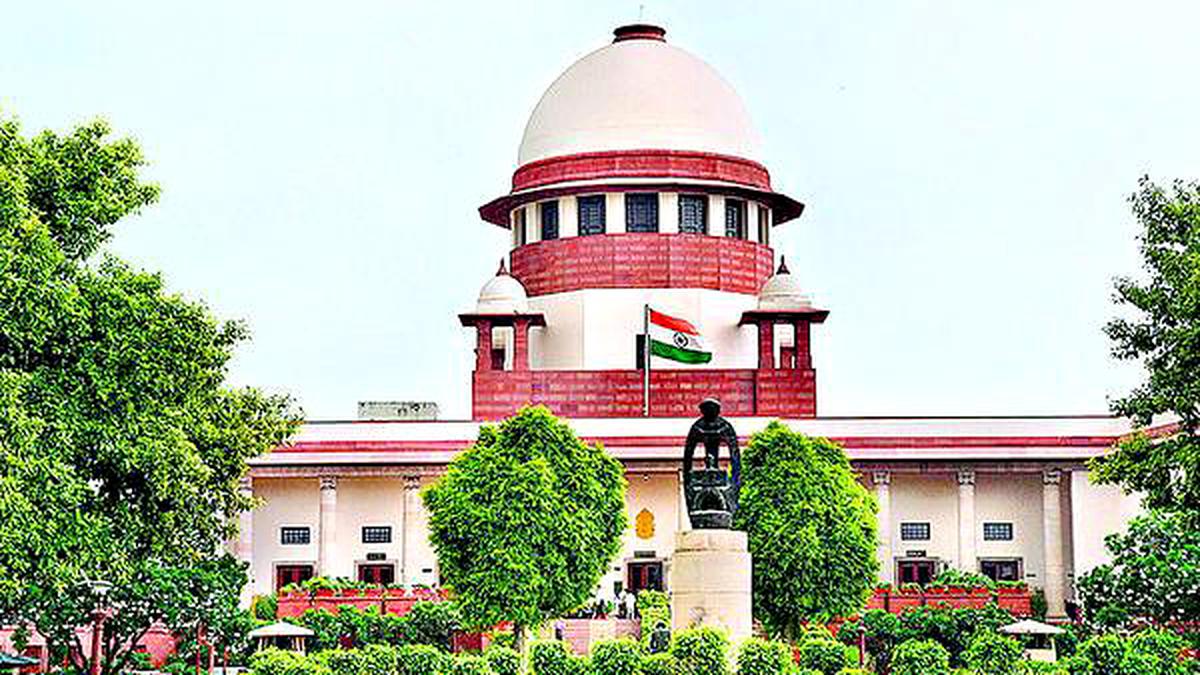

The significant observation was made by a Bench of Justices S.V.N. Bhatti and N.V. Anjaria in its judgment delivered on October 16, by which it dismissed a Rajasthan police constable's appeal challenging the framing of a corruption charge against him.

Section 7 of the PC Act, as amended in 2018, punishes public servants who accept, obtain or attempt to obtain an undue advantage to improperly or dishonestly perform a public duty.
The Supreme Court rejected the constable's defence that a prior approval for an inquiry or investigation into certain offences linked to decisions or recommendations made by public servants in the discharge of their official functions under Section 17A of the PC Act was not taken by the investigating agency.

Referring to various judgments, the verdict said it was stated that offences such as misappropriation, falsification of accounts, cheating, criminal breach of trust, receiving bribes are beyond the scope of the provision.

"The language of the provision itself outlines and circumscribes the ambit of operation of the provision. The decisive phrase in the Section is 'discharge of official functions or duties'," it said. The court, however, pointed out that the legislature intended to protect a public servant from being prosecuted by engrafting Section 17A in the statute book.
Observing that the Section cannot be viewed to have an "omnibus application", it said, "In order that the provision of Section 17A of the PC Act applies, there has to be a 'decision' or 'recommendation' by a public servant against whom an enquiry or investigation is to be initiated.
"Such 'decision' or 'recommendation' shall be a 'decision' taken or 'recommendation' made by such a public servant in the discharge of his official functions or duties. "
“Thus, from the plain language of the provision of Section 17A, it is evident that the provision is confined to be applied in the situations where there is a recommendation or a decision taken by a public servant in the discharge of his official duties,” it said.
According to the case records, Tejaram was posted at the office of the deputy superintendent of police in Rajasthan's Sirohi.
A fellow constable, Devendra Kumar, alleged in an email complaint dated April 22, 2021, that Tejaram demanded ₹1.5 lakh on behalf of the superintendent of police. An FIR was registered on June 4, 2021, under Section 7A of the PC Act and Section 120B (criminal conspiracy) of the Indian Penal Code. Tejaram was arrested on September 1, 2021.
Following the grant of prosecution sanction under Section 19 of the Act on December 8, 2023, a charge sheet was filed on January 19, 2024. A special court in Rajasthan's Pali framed a charge under Section 7 of the PC Act on September 12, 2024.
Tejaram challenged the order before the high court, which dismissed his revision petition on March 26, 2025, prompting him to approach the Supreme Court.