How did scientists measure Mercury’s shrinking?
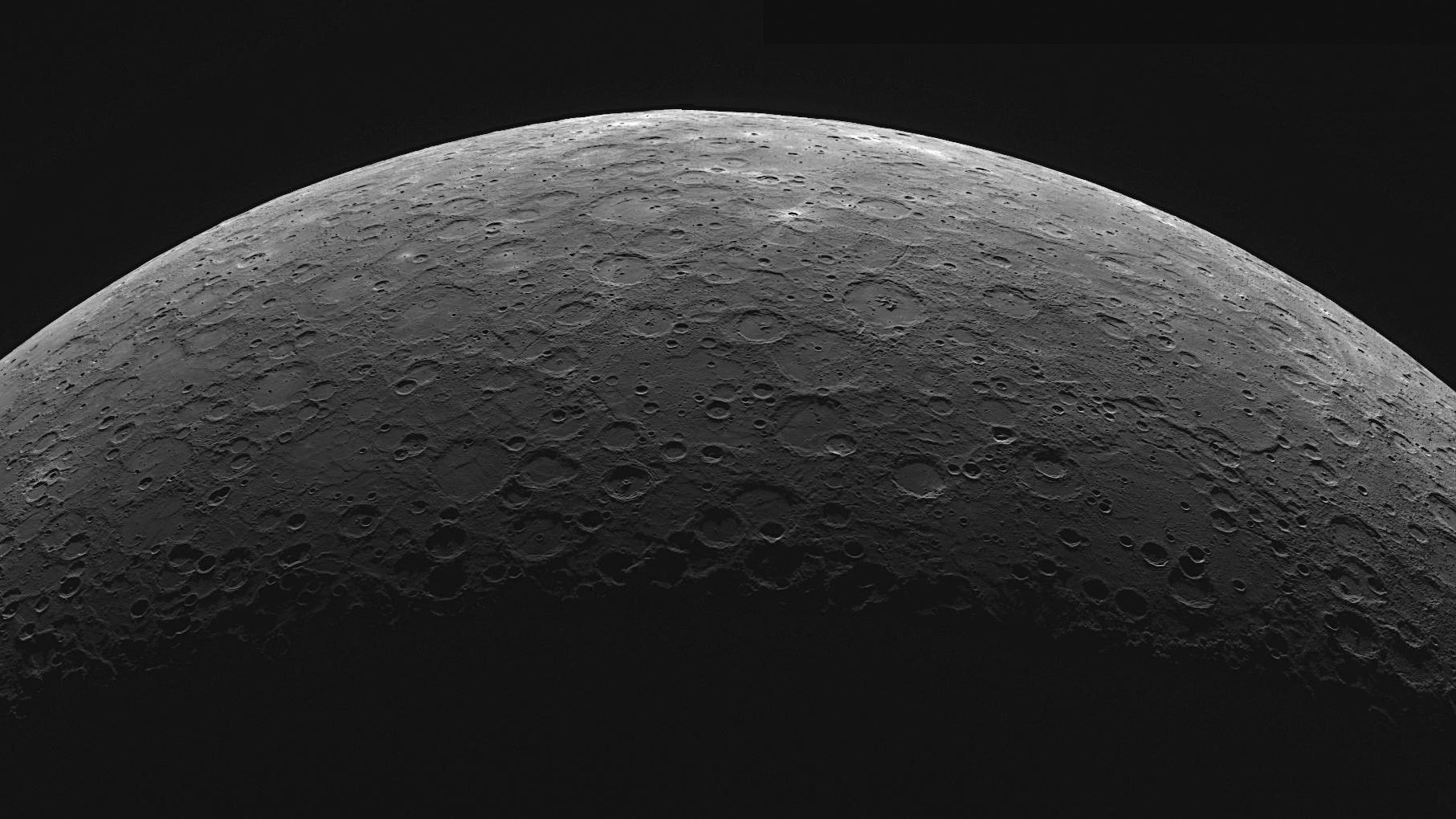
The findings come courtesy of data gathered by the of the planet before running out of fuel and crashing into the surface on April 30, 2015. In those four-plus years on the job, MESSENGER did a lot of work, studying Mercury with ; and a 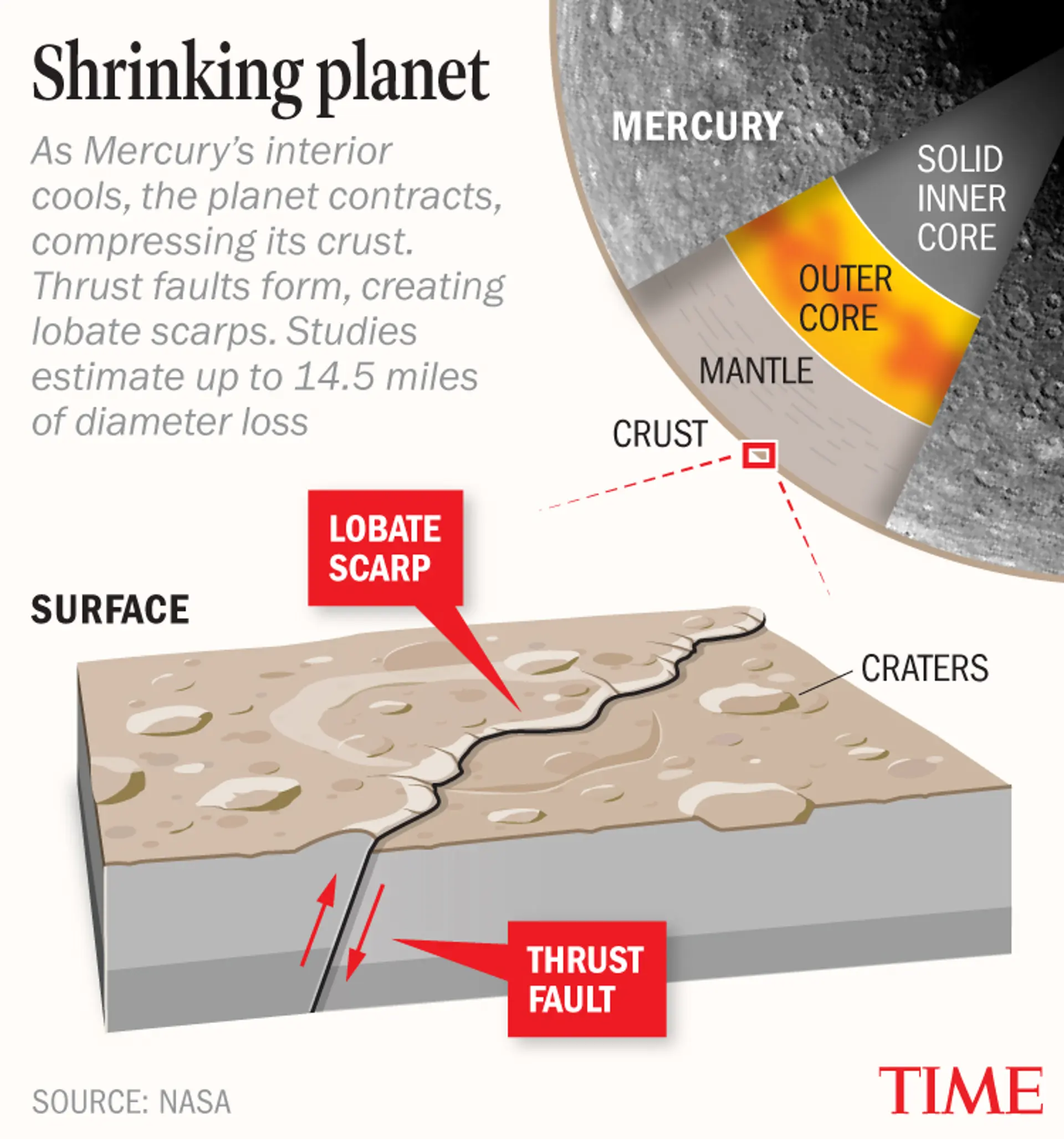
To confirm that conclusion, MESSENGER scientists used the spacecraft’s laser altimeter and dual-imager to scan the planet looking for so-called shortening structures, which are distortions in the surface made up of wrinkles, ridges, and what are known as lobate scarps—cliff-like structures that form when the crust pushes rock upward along a fault. Shortening structures form when a planet contracts; the greater the number of those surface features, the greater the planetary shrinkage has been.
Then too, there is the condition of Mercury’s surface itself. The shortening structures formed early in the planet’s history, and in the eons since, Mercury has been steadily pounded by incoming asteroids, gouging out craters and scattering debris, obscuring the telltale scars of planetary contraction. It’s possible to read through that rubble—tracing shortening structures until they are covered up by craters or rocks and estimating what their course and reach was—but that takes planet-wide three-dimensional maps, something that MESSENGER did not provide. There was, however, a way to create them.
What can Mercury’s shrinking teach us about the planet and our solar system?
That 30% factors out to about 4.5 miles more contraction than earlier calculations—small even on the scale of a world as modest as Mercury, but significant all the same. Increased shrinkage means planetologists have to rethink what they previously believed about the chemical composition and temperature of Mercury’s core, with lower sulfur or silicon content than previously believed, leading to faster cooling and more contraction. It could also suggest that Mercury’s core started out hotter than suspected, which resulted in a more dramatic volume change when it finally did cool down.
What Nishiyama and his colleagues learned about Mercury’s cooling and shrinking could have implications for the study of other rocky worlds like the moon and Mars. The moon has more craters and other rough features than Mercury, making it more important to try to interpret the shortening structures that did survive in order to estimate potential lunar shrinkage—learning if what happened on Mercury indeed happened on the moon and perhaps Mars. If so, says Nishiyama, all three worlds are likely to be contracting still, as heat continues to escape from their interiors into space.
Meantime, Mercury will get a closer look soon. In 2018, the European and Japanese space agencies launched the “New data from BepiColombo will open a door for understanding how Mercury has been shaped up to now,” says Nishiyama.