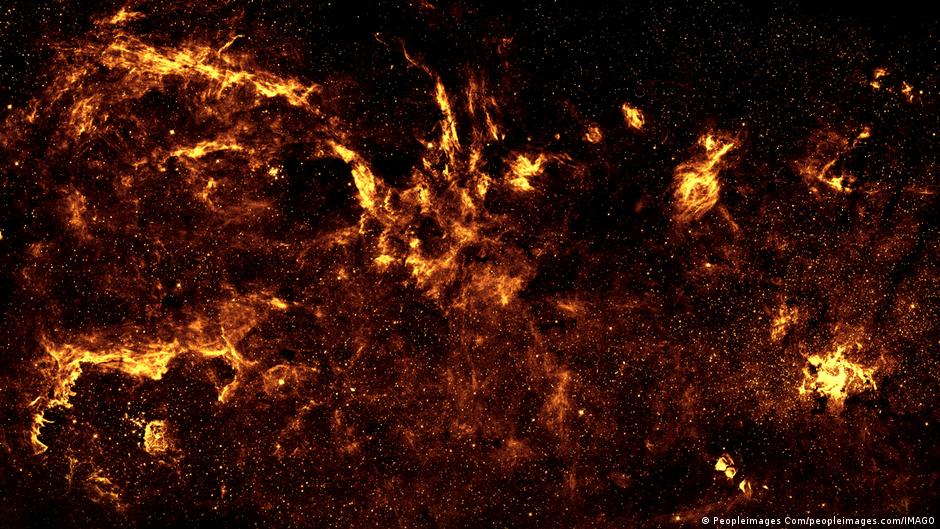
The team, based in South Dakota in the US, said the event resembled what they think a dark matter particle should produce when it collides with liquid xenon, one of a range of materials used for detecting dark matter.
They stopped short of calling it the discovery, or proof of dark matter, that many in the field have been hunting for almost 100 years.
The term "dark matter" was coined by physicist Fritz Zwicky in 1933 as a means to describe unseen matter that would explain fast-moving galaxies.
The LUX-ZEPLIN observation came just days after the release of the second season of Dark Matter, a sci-fi thriller starring Joel Edgerton and Jennifer Connelly. Both events pushed the term "dark matter" back into people's minds.
Here's what you need to know, with the science separated from the series.
What is dark matter in simple terms?
Dark matter is often described as an "invisible" substance. But it may be better described as "transparent" because it can be seen, or detected, by the gravitational attraction it exerts.
That said, it neither emits nor reflects light, and has never been observed directly. So, in that sense, it is invisible.
Is it true that 95% of the universe is invisible?
Yes, roughly.
Ordinary matter — everything that can be seen or touched — accounts for about 5% of the universe.
Dark matter accounts for about 27%, and , a separate force linked to the accelerating expansion of the universe, about 68%. Together they account for about 95%.
A different figure of 85% is dark matter's share of matter alone.
But does dark matter really exist?
The strongest evidence that dark matter exists comes from the so-called Bullet Cluster, which formed when two clusters collided. The collision produced hot gas clouds that interacted. This interaction showed revealed mass in the gas clouds that distributed differently from the gas. Researchers said that mass could be dark matter.
